
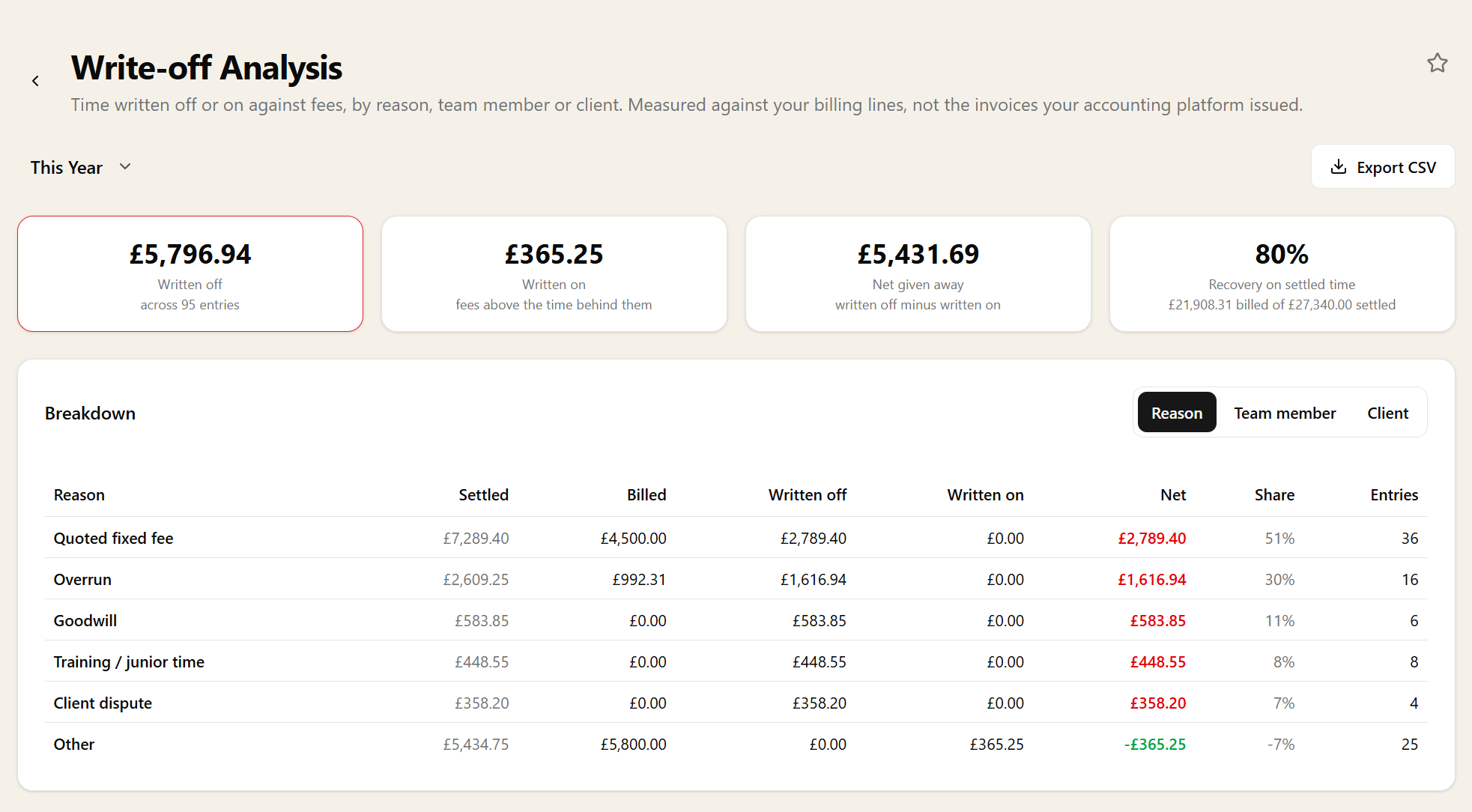
Write-off Analysis
How much time are you giving away — and why?
Every pound of time written off over the period — and every pound written on, where a fee came in above the hours behind it — grouped by the reason it was given, the team member who logged the time, or the client it was for.
A write-off is a decision, not a discovery
Sodium records a write-off at the moment it happens. Bill a client a fee below the value of the time and the difference is recorded, with a reason, against every entry it touched; write an entry off outright from the time list and the same thing is recorded with no bill at all. Either way the report is built from choices your team made, each with a reason attached, rather than from a reconciliation someone attempted months later.
That is what makes the number worth trusting. There is no separate write-off ledger to keep up to date and nothing to remember to do — if the time was not charged, the report already knows why.
The reason is the whole point
Six reasons come out of the box — Quoted fixed fee, Overrun, Goodwill, Client dispute, Training / junior time, Other — and you can add your own. Grouped by reason, one uncomfortable total splits into problems that need different fixes: a fixed-fee write-off is a pricing problem, an overrun is a scoping one, training time is the cost of building a team and should be expected, and a dispute is a relationship to manage.
"We wrote off fourteen thousand pounds last quarter" is a mood. "Nine of it was quoted fixed fees on three clients" is a repricing exercise with names on it.
Written on counts too
A fee above the time behind it is a write-on, and it is counted separately rather than netted away silently. Net given away is written off minus written on, and it is the honest figure: a practice that writes on as much as it writes off is pricing on value rather than hours, which is fine, while one that only ever writes off is leaking.
The recovery rate on settled time sits alongside — what was billed as a share of everything settled in the period — so the write-offs are read against the work they came from rather than in isolation.
By person, and by client
Grouped by team member, the report shows whose time is being written off, and it needs reading carefully: a junior's hours are written off because they are learning, a senior's because a job was under-scoped, and those are different findings about different people. Grouped by client, it shows who is absorbing the goodwill — and each row's share of the net puts the three clients that account for most of it at the top.
That client view is where fee reviews start. A client whose work is written off every quarter for the same reason is not an unlucky run of jobs; it is a fee that was set for a different amount of work.
Measured against your billing lines
The figures are measured against the billing lines Sodium raised, not the invoices your accounting platform eventually issued. An amount edited on the platform after the line was pushed is invisible here, deliberately: the report counts what you decided to charge for the time, which is the decision worth examining.
Filtering, drilling in, and getting it out
Choose a preset period or your own dates, and switch grouping between reason, team member and client without losing your place. Export to CSV before a pricing review or a fee conversation with a client.
This report needs time tracking switched on.
Related reports
These answer the question next door. If this report tells you something is wrong, one of them usually tells you why.
Related features
The parts of Sodium this report reads from — set these up and the report fills itself in.