
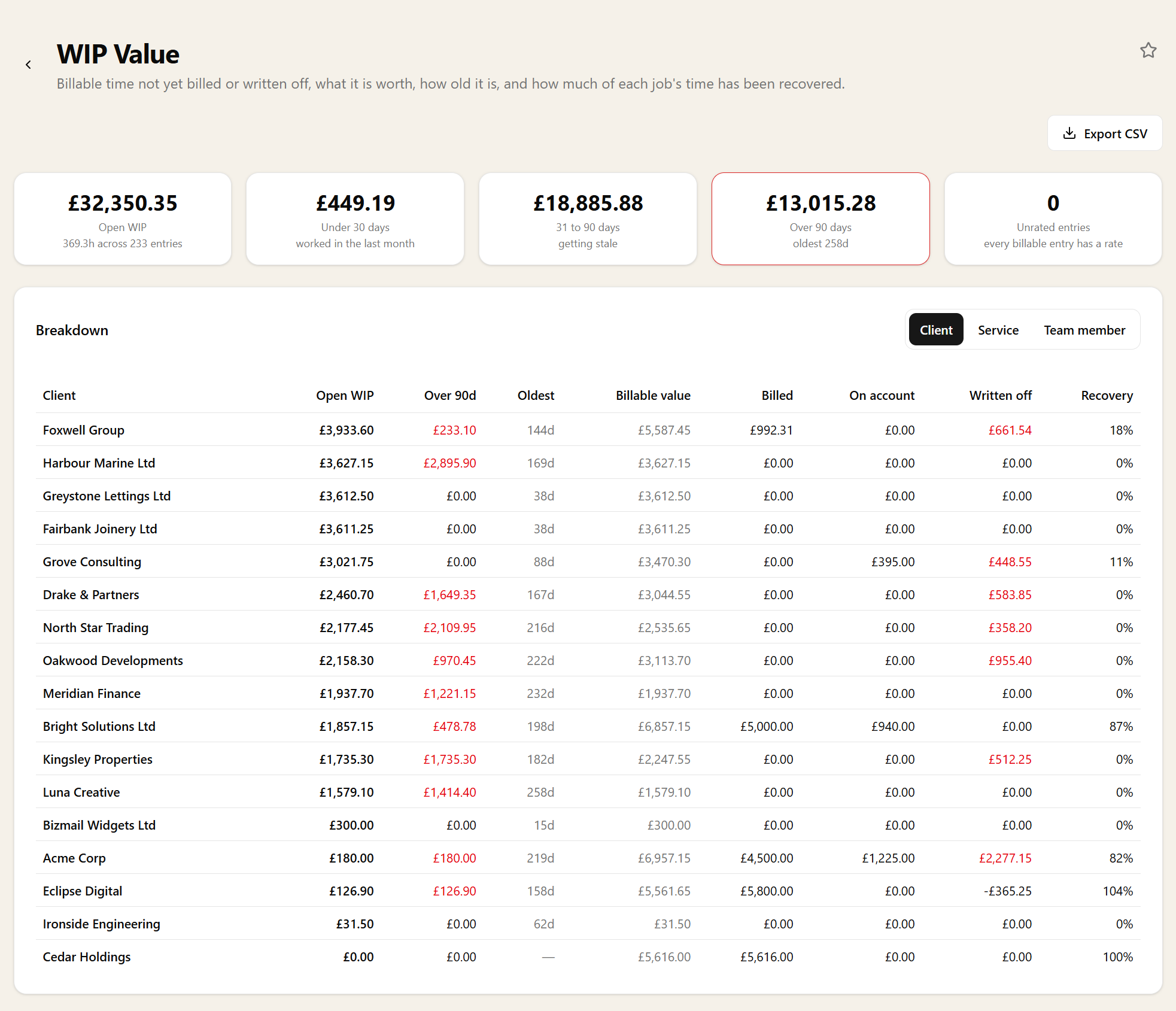
WIP Value
How much billable time is sitting unbilled — and how old is it?
Every billable hour that has not yet been billed or written off, valued at the rate it was logged at and aged from the day it was worked — by client, service or team member, with each one's recovery to date beside it, so under-billed work shows up before it turns into a write-off.
WIP is money you have not asked for yet
Unbilled time is usually the largest asset in a practice that nobody has written down. This is a live snapshot rather than a period report: what is open right now, in pounds, with the hours and entry count behind it — and it is what is left after billing and write-offs, so an entry billed in part shows only the balance still owed to you.
That makes it the number to know before a billing run, not after one. Open it on the first of the month and the headline figure is what you could invoice today if every client were billed in full.
Age is where the value leaks
Open WIP is bucketed by age — under thirty days, thirty-one to ninety, over ninety — counted from the day the time was worked, not the day someone got round to logging it. The over-ninety bucket is the one to open. Time that old is hard to bill: the client has forgotten the work, the job has moved on, and every month it sits there it becomes a little more likely to be written off than invoiced.
Each row also carries the age of its oldest open entry, which is usually the fastest way to find the one job everyone has quietly stopped mentioning.
Recovery, while there is still time to do something about it
Beside the open balance, every row shows its history in full: what the billable time was worth, what has been billed from it, what was billed to the service on account, what was written off, and the recovery rate that falls out of those. A client at sixty per cent recovery with a large open balance is a fee conversation to have now, not a write-off to discover at year end.
The on-account column matters most for fixed-fee practices. A monthly fee is billed to the service, not to the hours, so a job can look entirely unbilled on time and still be paid in full — the report shows both, rather than making a fixed-fee client look like a bad debt. It is left out when grouping by team member, because a fee belongs to the client, not to whoever did the work.
Time that cannot be valued
A billable entry logged with no hourly rate holds time but no value, and the report will not pretend otherwise. Those entries are counted in the headline and flagged on the row they belong to, so a suspiciously low balance can be traced to the rate that was never set rather than taken at face value.
Filtering, drilling in, and getting it out
Group by client, service or team member. A client's row opens Unbilled Time filtered to them across all time, and the headline balance opens the same page for the whole practice, so the number leads straight to the entries you would bill to clear it.
Export to CSV for a partners' meeting or a month-end review.
This report needs time tracking switched on.
Related reports
These answer the question next door. If this report tells you something is wrong, one of them usually tells you why.
Related features
The parts of Sodium this report reads from — set these up and the report fills itself in.